Nitrogen Purging
Safeguarding Asset Integrity in Energy Operations
In the energy sector there is little room for error during plant commissioning, turnarounds, and general pipeline maintenance. Undetected errors can lead to devastating result, severe corrosion and extremely costly operational delays.
The management of nitrogen purging is critical to ensure the prevention of such scenarios.
What Is the Purpose of Nitrogen Purging?
Nitrogen purging (also known as nitrogen drying) is a maintenance technique that flushes out oxygen, moisture and remnant hydrocarbons from industrial and energy systems.
This process enhances safety during plant maintenance. Onshore and offshore maintenance services in particular are at risk of potential combustion scenarios if the equipment is not sufficiently purged before maintenance.
Nitrogen purging is the controlled injection of nitrogen gas into a process system, such as subsea headers, storage tanks, pressure vessels, and process manifolds, to expel unwanted gases, liquids, or moisture.
Why Purge with Nitrogen Gas?
Nitrogen gas is inert, making it safe for pipeline purging on complex systems that contain combustible material.
- Nitrogen is non-reactive under standard operating pressures and temperatures, making it safe.
- Liquid nitrogen, when vaporised on-site, yields dry gas with dew points frequently below -60C to -70C. This dry gas when injected into systems evaporates moisture.
- Maintaining a nitrogen “blanket” during long periods of shutdown prevents internal pipeline deterioration cause by stagnant moist atmospheric air.
Applications of Nitrogen Purging and Preservation
Pipeline purging and preservation support allow for a wide range of industrial and energy systems, including:
- Oil, natural gas, and petrochemical processing plants and refineries.
- Process pipelines and flowlines.
- Rotating and static equipment.
- Pressure vessels, tanks, and separators
- Offshore platforms and floating product storage and offloading vessels.
- Oil and gas systems or equipment in long-term storage or awaiting commissioning.
Nitrogen Purging Methods
Nitrogen purging techniques can be based on system size, configuration, and contaminant profile.
- Flow Displacement Purging – The nitrogen displaces contaminants using laminar flow. Ideal for large vessels and pipelines.
- Dilution Purging – The nitrogen is mixed with the existing gas stream, reducing oxygen and/or hydrocarbon contamination to a safe level. This method is typically applied when flow displacement is not suitable.
- Pressure-Vacuum Cycles – Used for reactors and tanks that require controlled pressurisation. Nitrogen purging introduces nitrogen gas at a controlled high pressure before a vacuum is created to eliminate contaminants.
Controlled Nitrogen Injection
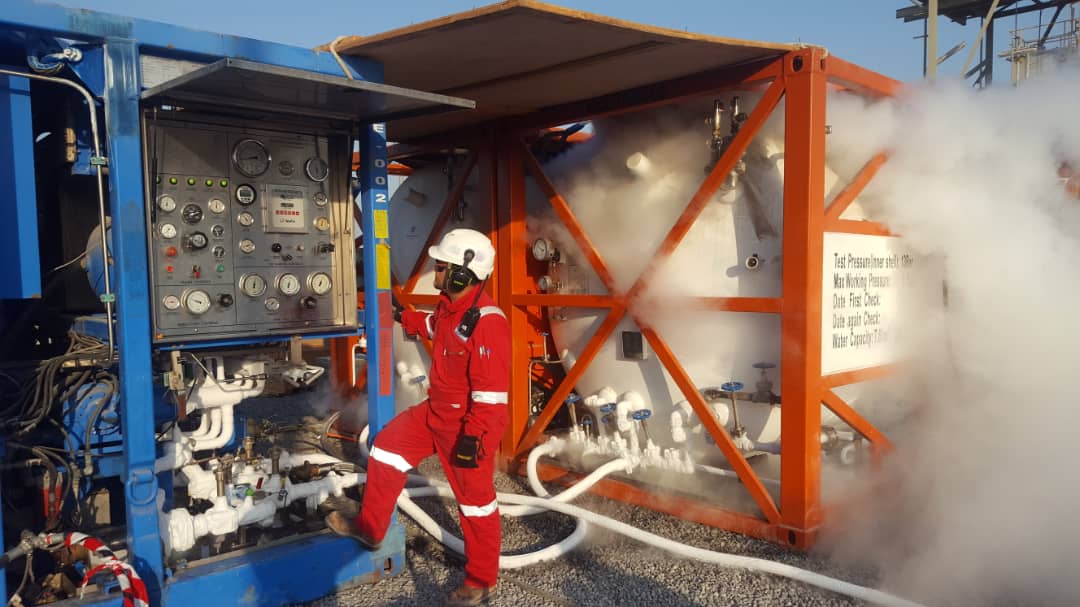
High-capacity liquid nitrogen pumping units can vaporise nitrogen on-site and inject gas at a steady and controlled flow, monitoring pressures and temperatures to prevent thermal shock or over-pressurisation.
Oxygen & Gas Level Monitoring
Calibrated analysers and moisture meters are used to continuously monitor & test at targeted vent points. Nitrogen purging continues until oxygen drops below a target specification (typically less than 1%).
Once this verification is complete, vents can be sealed, leaving the system under a slight positive nitrogen pressure to prevent back-ingress of air ahead of plant handover.
The Dangers of Nitrogen Purging
Whilst its understood that nitrogen is a vital safety tool during pipeline maintenance and shutdowns, it’s important to recognise it still carries severe operational risks done incorrectly:
Asphyxiation
Being colourless and odourless and the fact that it easily displaces oxygen, if handled incorrectly can be very dangerous. There should be strict permit controls, wearable oxygen monitors, safety spotters and clear venting away from personnel areas.
Over Pressurisation
High flow vaporisers can convert liquid nitrogen into gas at very high expansion ratios, allowing for rapid pressure spikes. Its is essential to have calibrated pressure valves along with effective engineered relief routes.
Static Electricity Ignition
Fast gas streams can in some cases generate static sparks if lines contain particulates or are ungrounded, so its critically important to maintain controlled flow limits and electrical earthing across all flanges.
Why Choose MCCS for Oil and Gas Services
MCCS delivers safe, efficient, and cost-effective nitrogen drying and preservation solutions. Our trained and certified team conduct thorough on-site assessments, nitrogen requirement calculations, and provides you with solutions that fit your schedule and budget.
Our international onshore and offshore services are compliant with international standards. Ensuring smooth, safe, and efficient project performance.
Partnering with MCCS guarantees that your systems are dry, inert, leak-tested, and ready for hydrocarbon introduction on time and without incident.
If you are planning an upcoming turnaround, offshore hook-up, or pipeline maintenance project?
Contact the engineering team at MCCS International to review your plans and project specifications.
MCCS has had the privilege of serving a diverse portfolio of international clients