Services
Hydrotesting Services
Testing services for pipelines, piping systems, and industrial facilities.
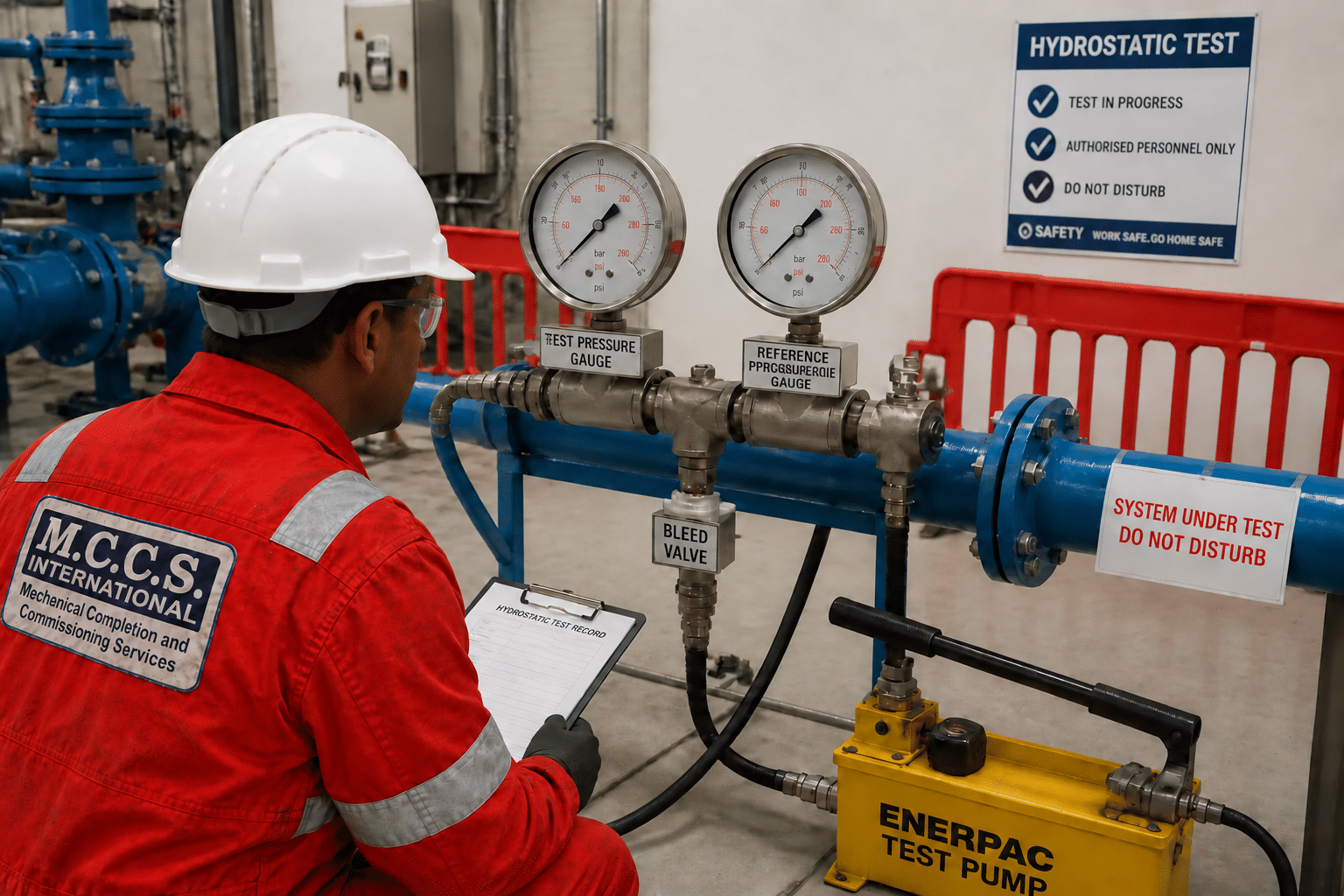
MCCS International is a leading provider of hydrostatic pressure tests for the oil and gas industry, supporting energy and industrial facilities from construction to commissioning and maintenance.
Hydrostatic pressure tests verify the integrity, strength, and leak tightness of piping systems, welded joints, and pressure-containing components in accordance with project specifications, client requirements, and international standards.
By simulating operating pressures under controlled conditions, hydrotesting ensures that systems are safe, reliable, and ready for commissioning and hydrocarbon introduction.
Note: Hydrotesting of pressure vessels is typically performed by the equipment fabricator and documented before site delivery. MCCS primarily conducts hydrotests for piping systems unless otherwise specified by the client.
What Are Hydrostatic Pressure Tests?
Also known as hydrotesting, this is an accurate pressure test used to confirm the structural integrity of process pipelines, ensuring they are leakproof.
The test fills a piping system with clean water or an approved medium and gradually pressurises it to 1.5 times the designed pressure. If the pipeline holds without leaks, this verifies that the system can safely withstand operational conditions.
Why Is Hydrotesting Important for Oil and Gas Projects?
Hydrostatic pressure tests allow operators of oil and gas projects to identify weaknesses or defects in pipelines that could result in serious safety or operational hazards.
Testing process pipelines ensures the system is safe ahead of commissioning and introduction of combustible hydrocarbons.
System Isolation and Preparation
Before hydrotesting begins, MCCS ensures that the piping system is fully prepared by:
- Isolating the section in need of testing
- Verifying valve, drain, and vent configurations
- Installing test equipment and conducting pre-test walkdowns.
- Reviewing test packs and engineering documentation
System Filling and Air Removal
The test section is filled ready for hydrostatic testing while ensuring that all trapped air is completely vented. This is essential for safety and achieving accurate test results.
Controlled Pressurization
The hydrostatic pressure test begins, and our team monitors:
- Pressure gauges and instrumentation
- System stability
- Temperature variations
- Structural response
For piping systems, hydrotest pressure is typically set to 1.5 times the design pressure, depending on project specifications and applicable standards.
Leak Detection and Integrity Verification
Once the required pressure is achieved, MCCS performs a detailed inspection of:
- Welded joints and flanged connections
- Valves and fittings
- Pipe supports
- Mechanical connections
These inspections check for leaks, pressure loss, deformation, and signs of structural defects or equipment failure.
Documentation and Certification
Following successful completion of the hydrostatic pressure test, MCCS issues comprehensive documentation for inclusion in system completion dossiers and turnover packages.
- Hydrotest certificates
- Pressure charts and test records
- Calibration certificates
- Inspection reports
- Test pack documentation
- Punch list observations
- Client-approved completion records
Choose MCCS for Breech-Lock Exchanger Services
Countless oil and gas projects requiring onshore or offshore platform maintenance rely on MCCS’ experienced teams to ensure breech-lock heat exchanger services are carried out safely and to the highest standards of quality.
For project inquiries, training, or support, reach out to our team today.
MCCS has had the privilege of serving a diverse portfolio of international clients