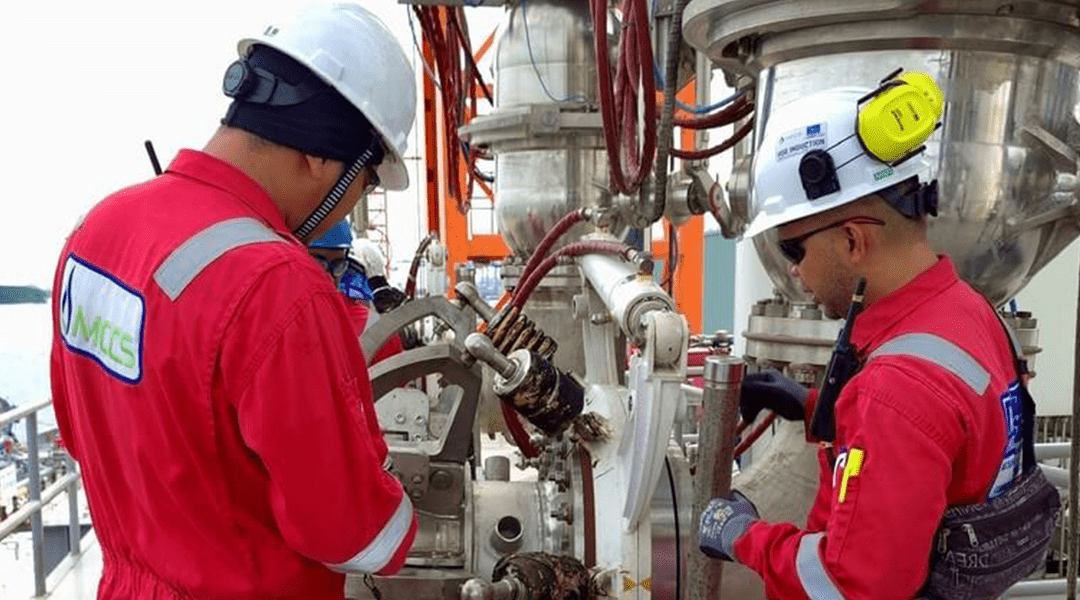
Why It’s Critical for Pre-Commissioning & Pipeline Integrity
Nitrogen Helium Leak Testing in Pre-Commissioning
Nitrogen helium leak testing is a highly sensitive, non-destructive diagnostic method used during the pre-commissioning phase of oil, gas, and petrochemical facilities. By utilising inert nitrogen as a carrier and helium as a tracer gas, microscopic leaks in complex piping and flange systems can be detected. This process ensures environmental compliance, operational safety, and leak-free startup for pipeline services and international offshore services.
What is Nitrogen Helium (N2/He) Leak Testing?
It is a test that pumps inert nitrogen and/or helium gas into a system that handles volatile materials in order to detect leaks. The inert nature of these gases allows for leaks to be detected safely, without damaging or reacting with the system.
There are two type of testing these are:
- Helium Sniffer Method: In the sniffer test, the system is pressurised with a nitrogen and helium mixture. A handheld sniffer probe is moved around external joints, where escaping helium will be detected by the probe. This test is commonly used to check flange joints, valves and piping systems before plant commissioning.
- Helium Vacuum Method: The system is placed under vacuum, and pure helium is pumped into the space outside it. Should any helium enter the system, it is detected by a mass spectrometer. This method is commonly used for critical pressure equipment, heat exchangers and systems where a test with high sensitivity is required, such as a factory acceptance test.
Why is Leak Testing Essential During Pre-Commissioning?
- Safe Startups: Identifies potential catastrophic leaks of volatile organic compounds (VOCs) before hydrocarbons are introduced.
- Compliance: Testing ensure Environmental & Regulatory compliance by minimising the carbon footprint and prevents chemical spills into various ecosystems, which is crucial for international offshore services.
- Asset Protection & Cost Savings: Testing can prevent any unplanned shutdown, asset damage, and costly unexpected emergency repairs.
- Integrates with Flange Management System: Clear testing ensures that controlled bolting and joint integrity procedures were performed correctly.
Why Choose MCCS as Your Nitrogen Helium Leak Test Vendor?
- System Isolation & Preparation: Our offshore or onshore maintenance engineers review drawings, P&IDs, and testing requirements to define the parameters of the test.
- Nitrogen Filling & Stabilisation: The system is safely purged of volatile substances and gradually filled with nitrogen to the required test pressure. Technicians then ensure the pressure is stable and monitor for any decay.
- Helium Injection and Leak Detection: Helium is introduced into the nitrogen-filled system. As a tracer gas, it will be picked up by MCCS’ leak detection instruments. Due to helium’s unique mass signature, even minute leaks can be precisely detected along flanges and joints.
- Repair, Rectification & Re-Test: If a leak is detected, MCCS’s expert technicians immediately perform controlled tightening and re-test on the spot.
- Final Documentation & Sign-Off: Delivery of detailed Joint Integrity Records, Pressure Charts, and Flange Management Checklists.
Secure Your Facility’s Integrity with MCCS
MCCS won’t compromise on safety. Our world-class pre-commissioning team is ready to deliver a structured and meticulous leak testing service for your next onshore or offshore project.
Contact the MCCS International team today to consult with our experts or request a custom proposal.
Why use N2/He leak testing?
N2/He leak testing is usually conducted during the pre-commissioning phase and immediately after mechanical completion and flange joint tightening, but before hydrocarbons or process chemicals are introduced into the system.
Why use N2/He leak testing and not the standard hydrostatic testing?
Hydrostatic testing uses water, whereas nitrogen helium leak testing uses gases. Gases do not introduce moisture, which could lead to rust, and allows for the detection of microscopic leaks.
What is the helium leak test sniffer method?
The helium leak test sniffer method uses a handheld device to detect escaping helium gas from a sealed system, identifying small leaks by sensing helium concentration around potential leak points
Why is helium used for leak testing?
Helium is non-toxic, non-flammable and an inert gas. It has a very small molecular size that allows it to penetrate into any microscopic cracks and pass through gaskets easily. This makes it easily detectable by mass spectrometers at incredibly low concentrations, providing accurate results.
How much pressure is needed for a leak test?
The pressure needed for a leak test typically ranges from 1.5 to 1.2 times the system’s maximum operating pressure, depending on the application and standards. However, it should never exceed the equipment’s rated pressure to avoid damage or failure.
How much does a leak test cost?
The cost of a leak test can vary depending on the method used, the size of the system, and the complexity of the test. Generally, it can range from $200 to $2,000 or more per test, with helium leak testing being more expensive due to equipment and gas costs.
Can MCCS provide both onshore and offshore leak testing services globally?
Yes. MCCS International offer both international offshore services and onshore pipeline maintenance. Using a team of certified engineering teams and their own bespoke Puma Plus software undertake projects worldwide, from Europe and the Middle East to Southeast Asia.
MCCS has had the privilege of serving a diverse portfolio of international clients