Nitrogen Helium Leak Testing
Ensuring leak-free operations in energy oil and gas facilities.
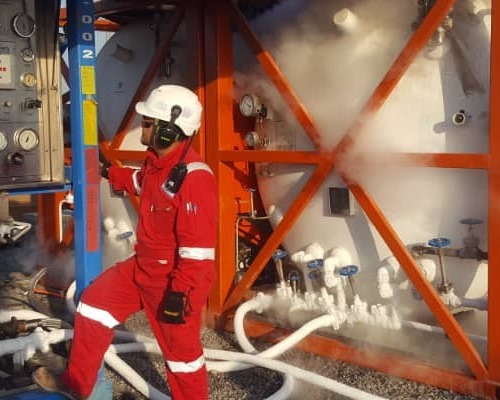
In the intricate landscape of onshore and offshore processing plants, maintaining safe operating conditions is paramount. With increasing complexity of offshore maintenance for oil and gas systems, the demand for stringent safety standards has never been higher. We offer comprehensive nitrogen helium leak testing as one of our international offshore services, to help ensure safe operating conditions are maintained.
What is a Nitrogen/Helium Leak Test?
It is a test that pumps inert nitrogen and/or helium gas into a system that handles volatile materials in order to detect leaks. The inert nature of these gases allows for leaks to be detected safely, without damaging or reacting with the system.
Two different techniques are used to detect leaks: high vacuum testing, which has a low detection threshold of 1×10⁻⁸mbar, and helium sniffing, which detects leaks down to 1×10⁻⁶ mbar.
Helium sniffer test
In the sniffer test, the system is pressurised with a nitrogen and helium mixture. A handheld sniffer probe is moved around external joints, where escaping helium will be detected by the probe.
This nitrogen-helium leak test is commonly used to check flange joints, valves, and piping systems before plant commissioning.
Helium vacuum test
The system is placed under vacuum, and pure helium is pumped into the space outside it. Should any helium enter the system, it is detected by a mass spectrometer.
This helium leak detection method is commonly used for critical pressure equipment, heat exchangers and systems where a test with high sensitivity is required, such as a factory acceptance test.
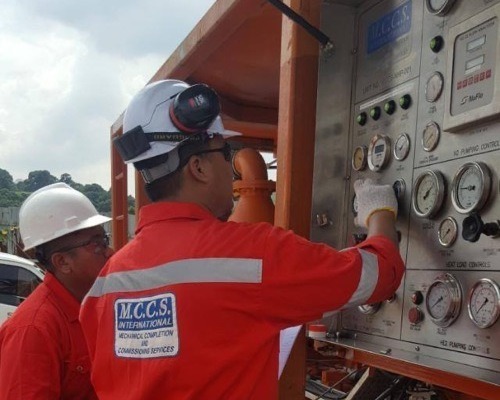
The following procedure is how a sniffer test is carried out by MCCS technicians.
1. System Isolation & Preparation
Our offshore or onshore maintenance engineers review drawings, P&IDs, and testing requirements to define the parameters of the test. This includes:
- Confirm all flanges, valves, and instruments within the test package are ready.
- Ensure all valves are set correctly to maintain the nitrogen helium leak test within the designated test section with no unintended openings.
2. Helium Injection and Leak Detection
Helium is introduced into the nitrogen-filled system. As a tracer gas, it will be picked up by MCCS’ leak detection instruments. Due to helium’s unique mass signature, even minute leaks can be precisely detected along flanges and joints.
All flanges, valves, seals, and welds are probed for helium.
Any detected leaks are immediately tagged and recorded.
As part of our international onshore and offshore service, MCCS technicians are fully qualified to repair all detected leaks and correct torquing where needed.
3. Final Sign-Off & Documentation
MCCS provides full reporting of your leak test results, including:
- Pressure charts
- Integrity certificates.
- ITRs
- Flange Management Checklists
- Joint Integrity Records
Choose MCCS as Your Nitrogen Helium Leak Test Vendor
Countless oil and gas projects across the world rely on MCCS’ maintenance teams to ensure their smooth, safe, and profitable operations.
For project inquiries or onshore and offshore maintenance support, reach out to our team today.
MCCS has had the privilege of serving a diverse portfolio of international clients